
Choosing Saddle Notching
(Note: ALL Faber® bridges come standard with saddles that have starter positioning notches. After choosing your saddle configuration, you may instead choose saddles WITHOUT notches.)
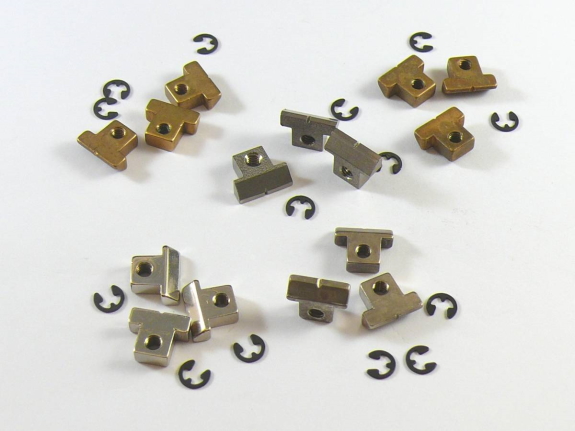
Starter Positioning Notches (Standard)
All Faber® bridges, regardless of model, come with saddles that are pre-notched with starter positioning notches only: a small notch, dead center, that positions each string. They can be used as is. The plain strings sit easily in the notches. The wound strings don’t, but under tuned string tension they bind a bit and won’t move side to side, and some players are satisfied with that. For best results we recommend notching the saddles to your string gauge. At minimum, deepen the wound-string notches. Otherwise the bridge’s 12″ radius is off.
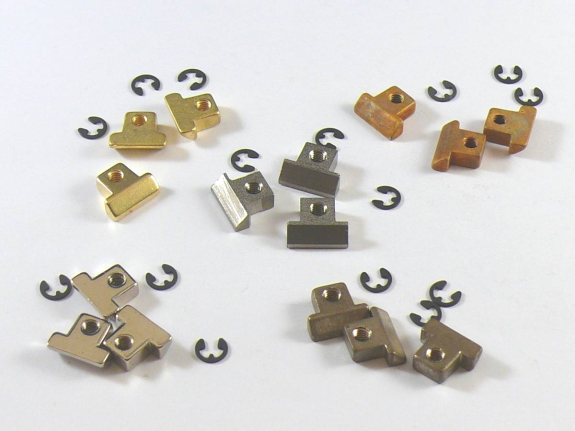
No-Notch Saddles (Optional)
If desired, FaberUSA can replace the standard saddles with no-notch saddles. We charge $15 for this service, using the “no notch” version of the saddle configuration you chose for your bridge. The saddles will then need to be notched to your preferred string gauge after installing the bridge on your guitar. This should be done with gauged notching files specifically for this purpose. As most casual guitar players don’t possess the required files, this operation will most likely need to be done by a qualified guitar technician.
Saddle notching: common questions
Can Faber’s pre-notched saddles with starter positioning notches be used as is?
Yes, but it’s discouraged. We recommend notching them to your string gauge, at minimum deepening the wound-string notches. Faber saddles come with starter positioning notches only. The plain strings sit easily in them. The wound strings don’t sit down in theirs, but under tuned string tension they bind a bit and won’t move side to side, so some players are satisfied with that.
What is a starter positioning notch?
A starter positioning notch is a small notch Faber cuts dead center on each saddle to position the string. It isn’t cut to any string gauge. That’s why it’s a starting point and not a finished notch.
Why should the wound-string notches be deepened?
Because unless the wound-string notches are deepened, the bridge’s 12″ radius is off. The wound strings don’t sit down in the starter positioning notches the way the plain strings do. Deepening those notches to your string gauge puts them back on the radius.
What causes a “sitar” sound from new saddles?
Leftover burrs in the plain-string notches can cause a sitar effect. The only fix is sanding, or filing, the burrs off.
Why does one string sound dead?
A string can sound dead if its notch isn’t properly gauged to the string. Notching each saddle to your string gauge avoids it.
Can I notch the saddles myself?
You can, if you have a proper set of gauged notching files. Doing the job right takes those files, and most players don’t have them. If you don’t, the only way to get the saddles notched properly is a guitar tech who has the right files. Inexpensive saddle and nut file sets can be found on Amazon. They do a crude job, but they’re better than nothing.
What tools do I need to notch guitar saddles?
A proper set of gauged notching files, one for each string gauge you need to cut. Many inexpensive saddle and nut file sets aren’t sized in imperial decimal inches, the way string gauges are. They’re sized in metric, so you’ll need to convert from metric to imperial decimal to pick the right file for each string. If a plain-string notch leaves burrs, sand them off to avoid a sitar effect.
I switch between two string gauges. Do I still need to notch?
Yes. You should still final-notch the saddles to your string gauge. Notch them for the lighter set, for example 8-38 if you switch between 8-38 and 9-42. You can always widen the notches later if you settle on the heavier set for good. A 9-42 set in notches cut for 8-38 only sits a fraction higher, which is barely noticeable with such a small gauge difference.
Should I choose starter positioning notches or no-notch saddles?
Most players should keep the standard starter positioning notches. Choose no-notch saddles only if you want to set each string’s position yourself, for example with off-center notches. No-notch saddles have flat tops and must be notched to your string gauge before the strings go on. On a new bridge, choose “Install Saddles Without Notches” ($15). Replacement 3-packs come both ways, except nylon saddles, which are only available without notches.
Are Faber saddle 3-packs treble- or bass-specific?
No. Faber saddle 3-packs aren’t specific to the treble or bass side. 3-packs with starter positioning notches have the same starter positioning notches as the saddles installed on a new Faber bridge. Two 3-packs re-saddle a whole bridge.
Do Faber saddle 3-packs include retaining rings?
Yes. Every Faber saddle 3-pack includes a new retaining ring for each saddle: 3 saddles, 3 retaining rings.
Do Faber replacement saddles fit a Gibson ABR-1?
No. Faber replacement saddles fit Faber bridges only (except the Wraptonate). They don’t fit a Gibson ABR-1 or any other brand’s bridge. To put Faber saddles on a guitar with a Gibson ABR-1, use a Faber bridge for ABR-1 posts, such as the ABRH or the Tone-Lock bridge for Gibson with ABR-1. It comes with saddles installed.